

UTV Mirrors – Buyer’s Guide, Fitment Basics, and What Actually Matters Off-Road
If you are looking for UTV side mirrors, you are not just buying shiny parts. You are protecting a machine that costs twenty to forty-five thousand dollars You did not finance that kind of money so you could bolt on the cheapest ABS Amazon special with rubber shims you can find. If you wanted that experience, you could have bought a two-thousand-dollar beater and called it a day.
Instead, you need UTV side mirrors that stay stable on machines like the Polaris Ranger, Can-Am Maverick, Polaris RZR, and Polaris Xpedition. This buyer’s guide explains how UTV mirrors really work, why clamp design matters, and how to choose the right setup for Polaris Ranger, Polaris Xpedition, Can-Am Defender, modern sport UTVs, and more. You will also see how Dirtbag Brands mirrors solve the usual problems without turning your ride into a science project.
For a deeper breakdown, see our comprehensive UTV Mirror Fitment Guide.


What Actually Matters When You Buy UTV Mirrors
Most marketing talks about “aggressive styling” and “wide view.” None of that matters if the mirror drifts, buzzes, or stares straight into your own cage.
When you pick UTV mirrors, focus on these points first:
- Stability
Mirrors should stay where you set them, even after hours of washboard and heat. If they sag every time the sun comes out, you are dealing with a bad clamp design. - Clamp design
There is a huge difference between form closure and friction closure. Form closure uses keyed geometry to lock the mirror in place. Friction closure uses ball-and-socket joints and bushings that creep over time. - Optic clarity
Real automotive glass with the right curvature gives you a clean, accurate view. Cheap acrylic warps, scratches, and turns every bump into jelly vision. - Vibration control
The glass and housing should move as one solid mass. If the glass “floats” inside the housing, it will buzz at a different frequency than the housing and blur the image. - Fitment and visibility
The mirror has to match your cage and your cab. It also has to clear A-pillars, doors, and bodywork so you can actually see behind you, not just your own plastic. - Accessory integration
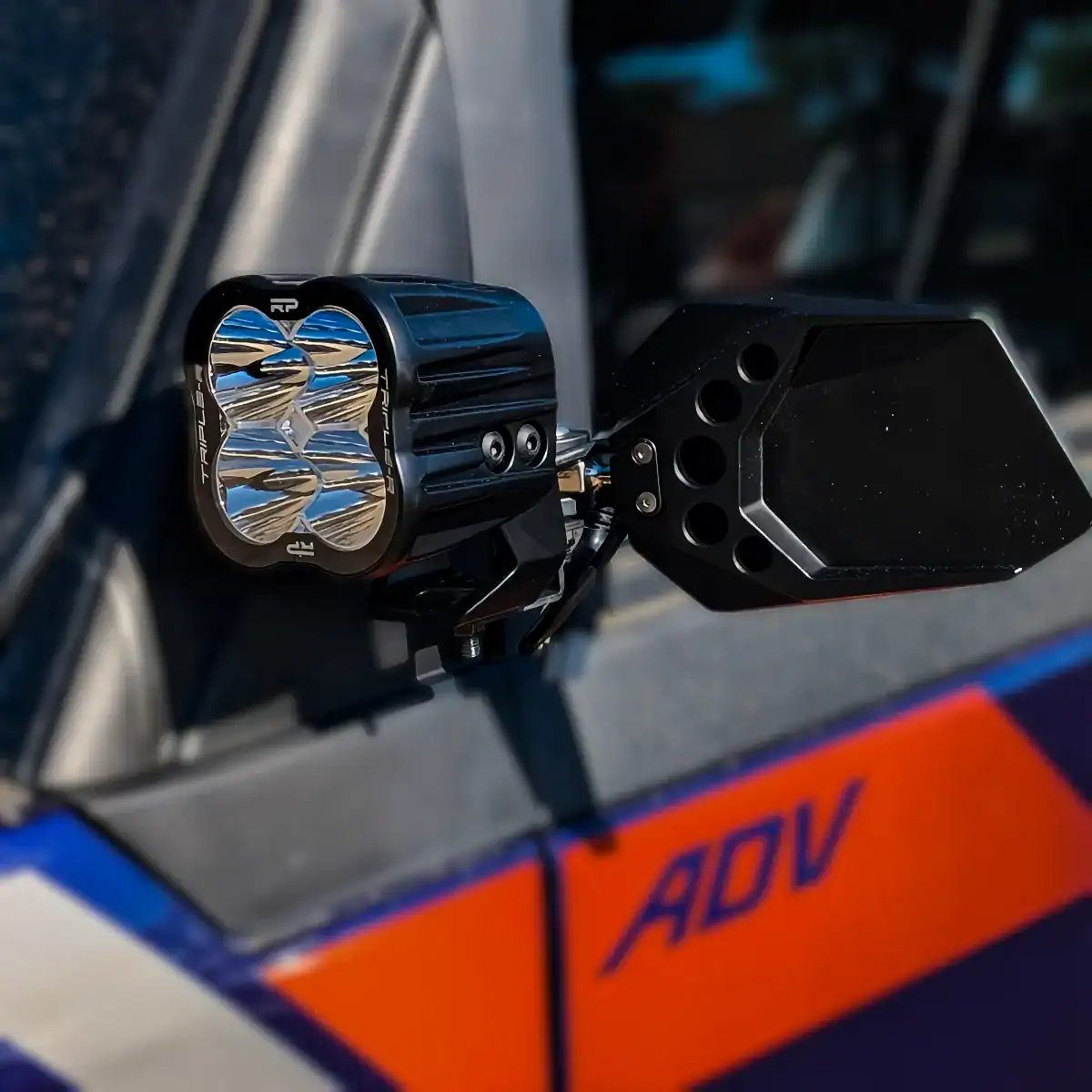
A good mirror clamp becomes a mounting point for pod lights, cameras, and other hardware. A bad one turns into a stack of brackets that vibrate and eventually crack.
If a mirror system misses on any of these, you pay for it every mile. For a deeper breakdown of clamp design and vibration control read our UTV Mirror Engineering.
Form Closure vs Friction Closure: Why Ball-and-Socket Mirrors Droop
Friction closure (ball-and-socket)
Most UTV mirrors still use a ball-and-socket joint. Two surfaces pinch together and try to hold position with friction. As the parts heat up in the sun, they expand. The clamping force drops, and gravity wins. Add trail vibration and dust, and you get classic “mirror droop.”
Ball-and-socket joints were literally designed for movement. If you do not believe that, think about your hip and shoulder. Both are ball-and-socket joints, and both exist to rotate and move through a wide range of motion. That is great for a joint in your body. It is terrible for a mirror that should stay locked in one spot while you drive.

Form closure (mechanical lock)

Form closure works differently. Instead of depending on friction, the mirror uses keyed geometry, interlocking teeth, and an indexed pivot. Once you set the angle and tighten hardware, the shape itself carries the load. The arm wants to return to that position, not creep away from it.
Dirtbag mirrors use a boss-indexed acorn pivot and interlocking clamp teeth so the mirror arm locks in place mechanically. If you smack a branch, the breakaway hinge deflects and can be reset. If you do not hit anything, the mirror stays where you left it.
👉 For riders who want the deeper engineering breakdown, link to:
Learn more: Form Closure vs Friction UTV Mirrors
Types of UTV Mirrors and Where They Fit
Now that you know why the clamp matters, you can look at the main categories of UTV mirrors and match each style to your machine.
Round Roll Bar UTV Mirrors
Round roll bar mirrors clamp to 1.75 to 2.0 inch round tubes. This covers most sport and performance platforms:
- Polaris RZR
- Can-Am Maverick X3
- Can-Am Maverick R
- Kawasaki KRX and Teryx H2
- Honda Talon and round-bar Pioneer trims
- Yamaha Wolverine RMAX
- Segway Villain and Super Villain
- Arctic Cat Wildcat XX
Here, Mirror-01 is your workhorse. It runs on round bars, includes 360 extension options, and comes with pod light mounts built into the system at no additional charge.
Dirtbag Brands uses Direct Bore Fitment
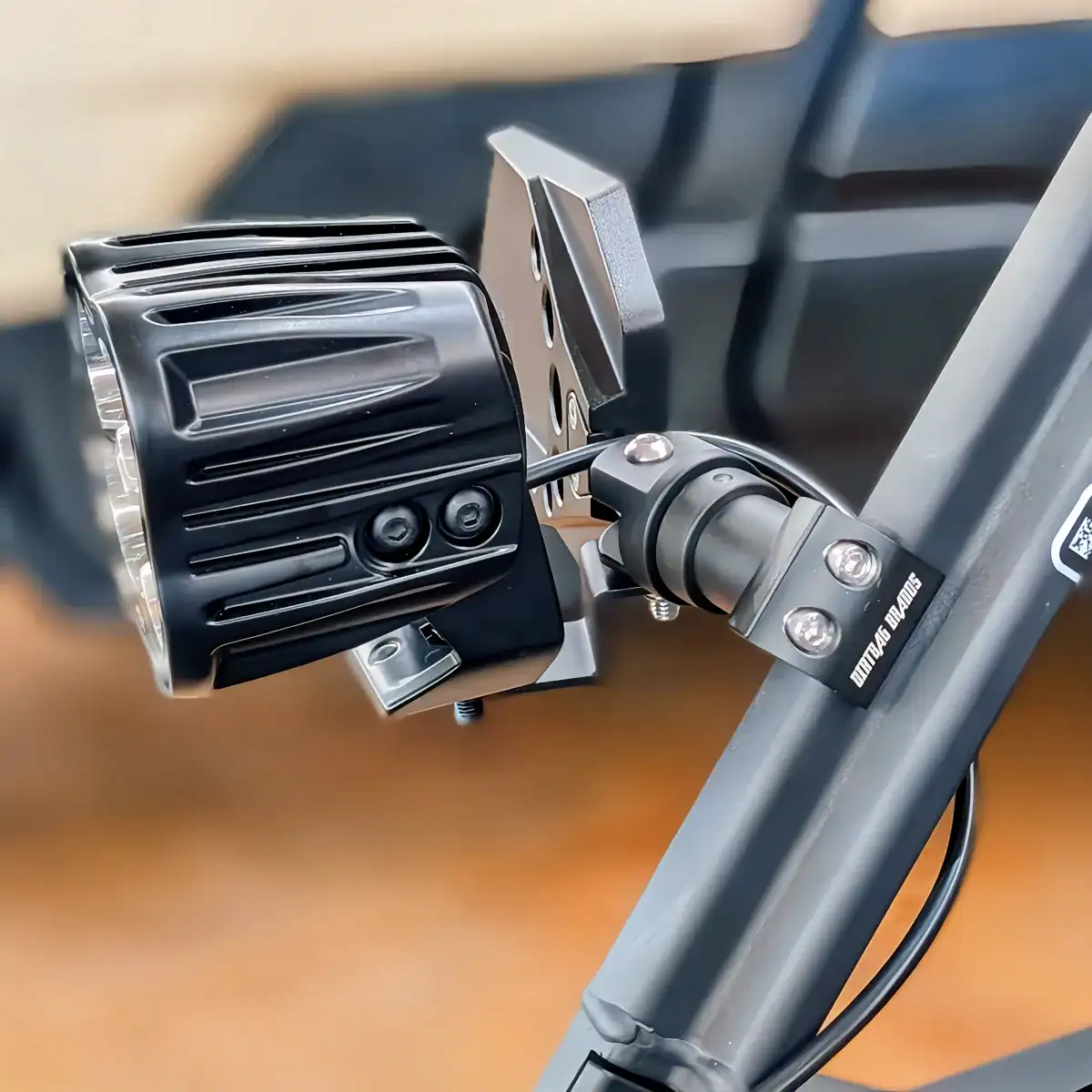
We reject rubber shims entirely. Rubber compresses under clamp force, acting like a spring that amplifies vibration. Our IronSight clamps are machined for Direct Bore contact (1.75″, 1.875″, or 2.0″). This Metal-on-Metal connection turns the mirror into a structural part of the cage. It is not just a “slim” accessory; it is a High-Density Billet component engineered for infinite mass damping. Our clamp is metal-on-metal.
Because of that, you can bolt lights to the same clamp and expand your field of view with additional lighting. That helps whether you are racing in the dunes at night, hunting in southern woods, crawling through swamp bogs, dodging trees in tight forests, or trail riding rock ledges in places like Moab.
For shoppers who just know they have a round cage, send them here first:
👉 UTV Mirrors – Round Roll Bar Fitment Guide



Profiled and Pro-Fit Cage UTV Mirrors
Profiled and Pro-Fit cages use shaped tubing instead of simple round bars. They show up on work and crossover machines like:
- Polaris Ranger XP 1000 (non-cab)
- Polaris Ranger XD 1500 (non-cab)
- Polaris General
- Polaris Xpedition
- Can-Am Commander (profiled trims)
- Can-Am Defender (non-cab)
- Can-Am Maverick Trail
- Can-Am Maverick Sport
- CF Moto UForce and 2023+ ZForce
- Segway UT series
Universal round clamps with rubber shims slide and twist on these cages. That is why Mirror-02 exists. It uses a profiled clamp that keys into the cage so you get a metal-to-metal relationship instead of a rubber-on-paint slip joint.
For a deeper breakdown, you can point readers to:
👉 UTV Side Mirrors – Profiled Cage Fitment
Cabbed UTV Mirrors: Ranger NorthStar, Defender Cab, and Similar Platforms
Cabbed UTVs change the rules. The doors, glass, and frames all get in the way of generic mirror arms. If you try to reuse a non-cab mirror, you usually end up with contact, limited movement, or a mirror you have to fold in just to open the door.
We have a complete article dedicated to cabbed machines such as the Polaris Ranger XP 1000, Ranger XD 1500, Xpedition ADV / XP, and Can-am Defender.
Key examples:
Polaris Ranger XP 1000 NorthStar and Ranger XD 1500 NorthStar
These machines run full doors and glass, so they need Mirror-04, a cab-specific design that clears everything and still gives a wide field of view.
👉 Polaris Ranger XP & XD Cab NorthStar Mirrors
👉 Polaris Ranger Side Mirrors for Cab Models


Can-Am Defender cab (2022 and newer)
Defender cabs need Mirror-03 on the door mount so the mirror sits where you can see past the boxy cab layout. This includes HD9, HD10, and HD11.
👉 Can-Am Defender Accessories & Mirror Fitment
Polaris Xpedition (ADV and NorthStar)
Xpedition uses Mirror-03 on the A-pillar panel. The doors open and close without ever hitting the mirror, and the glass sits where you can see around the vehicle instead of straight at sheet metal.
👉 Polaris Xpedition Accessories
👉 Polaris Xpedition & Can-Am Defender UTV Mirrors
Sport UTV Mirrors for Maverick R, X3, Pro R, and KRX


That geometry is why properly positioned UTV side mirrors matter so much on modern sport machines.
- Narrow A-pillars
- Wider hip sections
- Higher belt lines
- Long doors that flare outward
If you bolt a standard mirror tight to the cage, you often get a perfect view of your own bodywork and a terrible view of the trail behind you.
That is why Mirror-01 with the 360 extension arm matters so much here. It moves the optic forward and outward, then locks it in that position. As a result, you can actually see around the A-pillar and past the wide hips of machines like:
- Can-Am Maverick R
- Can-Am Maverick X3
- Polaris RZR XP, Pro R, and other updated platforms
- Kawasaki KRX and Teryx H2
- Yamaha Wolverine RMAX
- Honda Talon
- Honda Pioneer
- Kawasaki Mule Series
For machine-specific setups, see our Project Maverick and Project RZR as well.
Optic Clarity: Slight Convex vs Fisheye Distortion
Mirror shape matters just as much as mirror material.
Many cheaper mirrors use aggressive fisheye curvature. At first, that looks impressive because you can see a huge area. However, objects behind you look tiny and far away. That might be fine in a grocery store parking lot. It is dangerous when a turbo car is closing on you at speed or running a trail.
Dirtbag mirrors use real automotive-grade glass with a tuned slight convex radius. That balance gives you:
- Enough extra field of view to clear blind spots
- A realistic sense of distance and speed
- Less eye fatigue during long rides
This is closer to an automotive mirror than a “trucker” mirror. Trucker-style mirrors on utility UTVs often stack top and bottom panes to see trailers and equipment. They make sense when you back a trailer into a dock. On a side by side, you usually want an automotive-style mirror that lets you see the full trail behind you with one quick glance.
Structural Bonding: Why Glass Should Share the Housing’s Mass
Glass that floats inside the housing will always fight vibration. We call that the “Beehive Effect”. The housing moves with one rhythm. The glass moves with another.
What is the Beehive Effect
That “floating glass” behavior creates blur, buzz, and the classic “beehive” effect at engine RPM. This is why many high-end ‘Race’ mirrors still vibrate—they use a rigid clamp, but the glass floats inside. We bond ours to eliminate that secondary vibration.
Dirtbag Brands Solution to the Beehive Effect
Dirtbag mirrors use structural silicone bonding to fuse the glass to a heavy billet housing. Instead of two separate parts, the mirror behaves like a single solid mass. This approach:
- Dampens engine harmonics
- Eliminates glass rattles and edge buzz
- Keeps the image readable at speed
When you combine that bonding with a stable clamp, you get mirrors that stay quiet even when the machine does not.
Integrated Pod Light Mounts: Why Thickness and Placement Matter
Every Dirtbag Brands mirror includes pod light mounts at no additional charge, so you never have to buy a separate bracket kit to run lighting at mirror height. Because the pod light mount ties directly into the hinge and clamp structure, it shares the same strength and stability as the mirror arm. As a result, a thicker, properly braced light mount moves less at high speed and keeps your beam pattern exactly where you want it. The side-by-side comparison next to this shows the difference clearly: the Dirtbag pod light mount measures 0.12 inches thick, while a typical competitor bracket sits at 0.10 inches. That extra material helps resist flex and vibration in whoops, dunes, or chopped-up desert, which is why your lights stay steady instead of chattering around the trail. Mounting lights at mirror height also improves depth perception, reduces hood glare, and expands your field of view into the corners of the trail. These advantages matter whether you are carving dunes at night, weaving through tight forest sections, hunting in low-light woods, running swamp roads, or crawling slick rock in Moab.
Independent Light Axis Mount
Many “integrated” mirror mounts force you into a compromise: if you move the mirror to see behind you, your light moves with it. Dirtbag Brands solves this with our Independent Light Axis architecture.
The Structural Pod Light Mount anchors to the primary hinge bolt for maximum rigidity, but it rotates on a completely separate axis from the mirror glass. This means you can aim your pod lights exactly where you need them—straight ahead for high-speed spotting or angled wide for cornering visibility—without ever messing up your rear-view angle. You get the stability of a unified system with the adjustability of a standalone mount.


Fitment Basics: How to Choose UTV Mirrors in Three Steps
Step 1: Identify Your Cage and Cab
Round bar machine
→ Start with Mirror-01 and the Round Roll Bar Fitment Guide.
Profiled or Pro-Fit cage
→ Start with Mirror-02 and the Profiled Cage Fitment Guide.
Cabbed Polaris Ranger XP 1000 NorthStar or Ranger XD 1500
→ Go directly to Mirror-04 on the Ranger Cab Mirror Page.
Can-Am Defender Cab or Polaris Xpedition (ADV, XP, & NorthStar)
→ Use Mirror-03 and check both:
Step 2: Match Mirrors to Your Riding Style
Trail and family rides
- Prioritize clarity, slight convex glass, and vibration control
Dunes, desert, and group runs
- Prioritize structural bonding and clamps that lock in place at speed
Overlanding and night rides
- Take advantage of the included pod light mounts and mirror-height lighting
Step 3: Build your accessory ecosystem off the same clamp
Because the IronSight clamp also supports whip mounts, Rotopax, and fire extinguisher mounts, you can keep adding hardware without playing bracket Jenga.
You can link out to:
UTV Mirror FAQs
No. UTV mirrors must match your cage style and, often, your cab. Round roll bar mirrors fit 1.75 to 2.0 inch round tubes. Profiled and Pro-Fit clamps fit shaped cages. Cabbed machines like Ranger NorthStar and Defender Limited also need specific arms that clear doors and glass.
Most drooping mirrors use friction-based ball-and-socket joints. Heat, vibration, and time reduce clamping force. Because ball-and-socket joints were designed for movement, they naturally want to rotate. Mirrors that use mechanically indexed pivots and interlocking teeth stay locked in place instead.
If you already spent tens of thousands on your UTV, it makes sense to run hardware that can keep up. Billet mirrors with structural glass bonding, mechanical locking pivots, and solid clamps give you a clearer view, less vibration, and a much longer service life than thin plastic mirrors.
High quality UTV mirrors use automotive-grade glass with a tuned slight convex curve. That combination widens your field of view without fisheye distortion. Plastic or acrylic mirrors often warp with heat, scratch easily, and distort distance.
Yes. Every Dirtbag Brands mirror includes pod light mounting at no extra charge. The light mount ties into the clamp and hinge structure, which keeps the beams stable at speed.
Use the master fitment hub:
👉 UTV Mirror Fitment Guide
Disclaimer:
This guide provides general information on UTV mirror fitment, clamp design, and off-road visibility. Because every machine, cage style, and accessory setup can vary, riders should verify all fitment details before installation. Dirtbag Brands mirrors are engineered for a wide range of platforms, yet vehicle modifications, aftermarket cages, and non-OEM accessories may affect compatibility. Always follow proper installation procedures and use appropriate safety precautions when working with billet components, lighting systems, or hardware. If you are unsure which mirror fits your machine, consult the official Dirtbag Brands Fitment Guide or contact our support team for assistance.
Follow Dirtbag Brands in Google
Add Dirtbag Brands as a Preferred Source for more UTV fitment guides, product testing, powersports news, and industry coverage.

Comments are closed